Sebastian Nasta
.ART Award 2026
The Story Behind the Work
Painting · Cluj-Napoca, Romania

False Salvator Mundi

2022–2024 · Oil on linen · 257 × 206 cm

I spent years constructing a face, then scratched the portrait from the painting and preserved the removed paint in a glass jar.

False Salvator Mundi, final large-scale oil painting by Sebastian Nasta
False Salvator Mundi, final work. 2022–2024. Oil on linen. 257 × 206 cm.

False Salvator Mundi is a large-scale oil painting in which a hyperreal portrait is first constructed and then physically interrupted. The painted face is scratched from the linen, the removed paint is preserved in a glass jar, and the altered surface is overwritten with painted pseudo-code that classifies identity through layers of body, behavior and social visibility.

Medium
Oil painting
Materials
Oil paint on linen; removed paint fragments preserved in glass
Dimensions
257 × 206 cm
Period
2022–2024
Tools / process
Artist brushes; manual scratching of the painted surface
Process record
Approx. 3,800 hours; 141 brushes
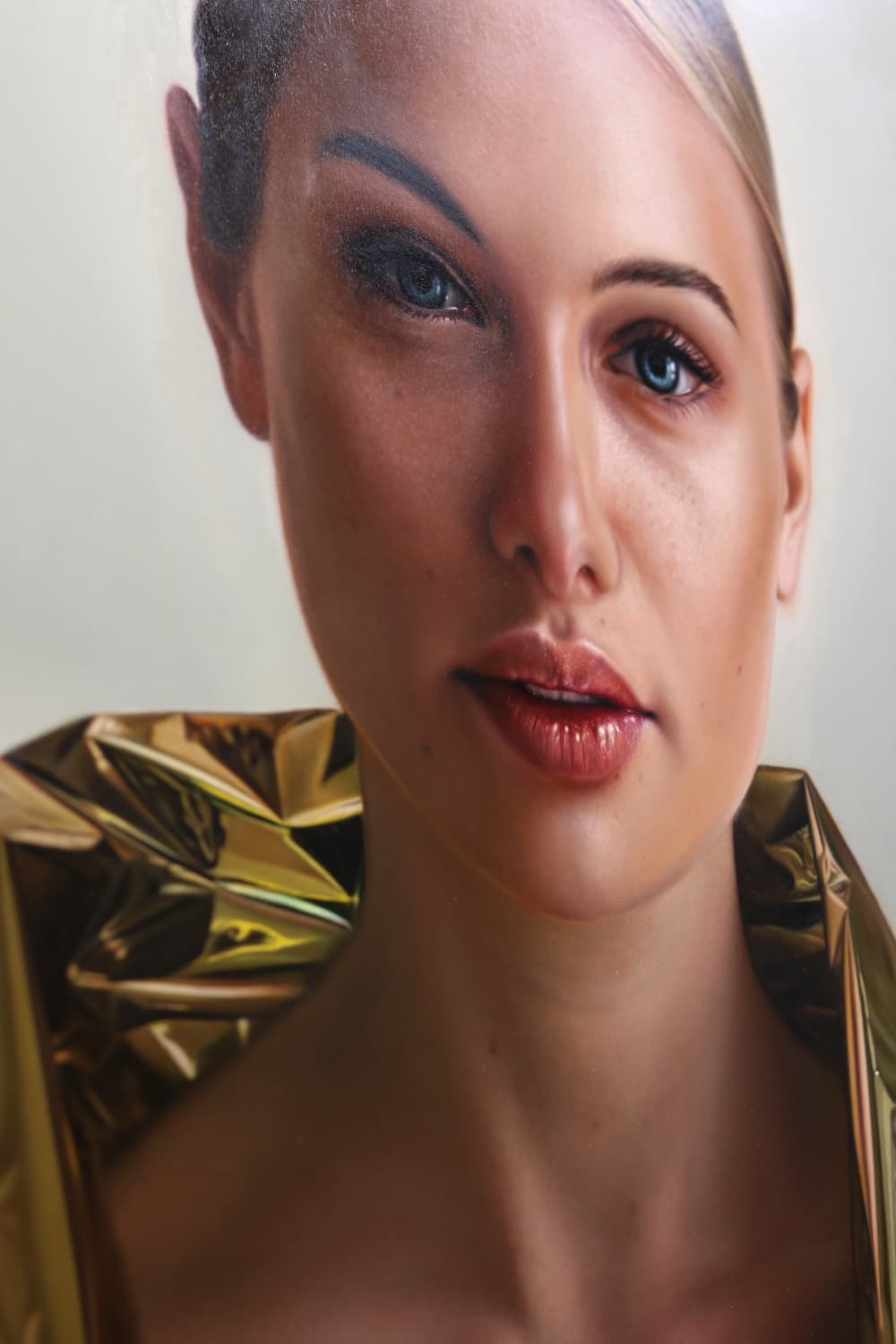
The painting before the facial intervention, with the portrait intact
Before intervention: the fully constructed portrait.
The final painting after the face was scratched and overwritten
After intervention: the portrait removed from its expected place in the image.
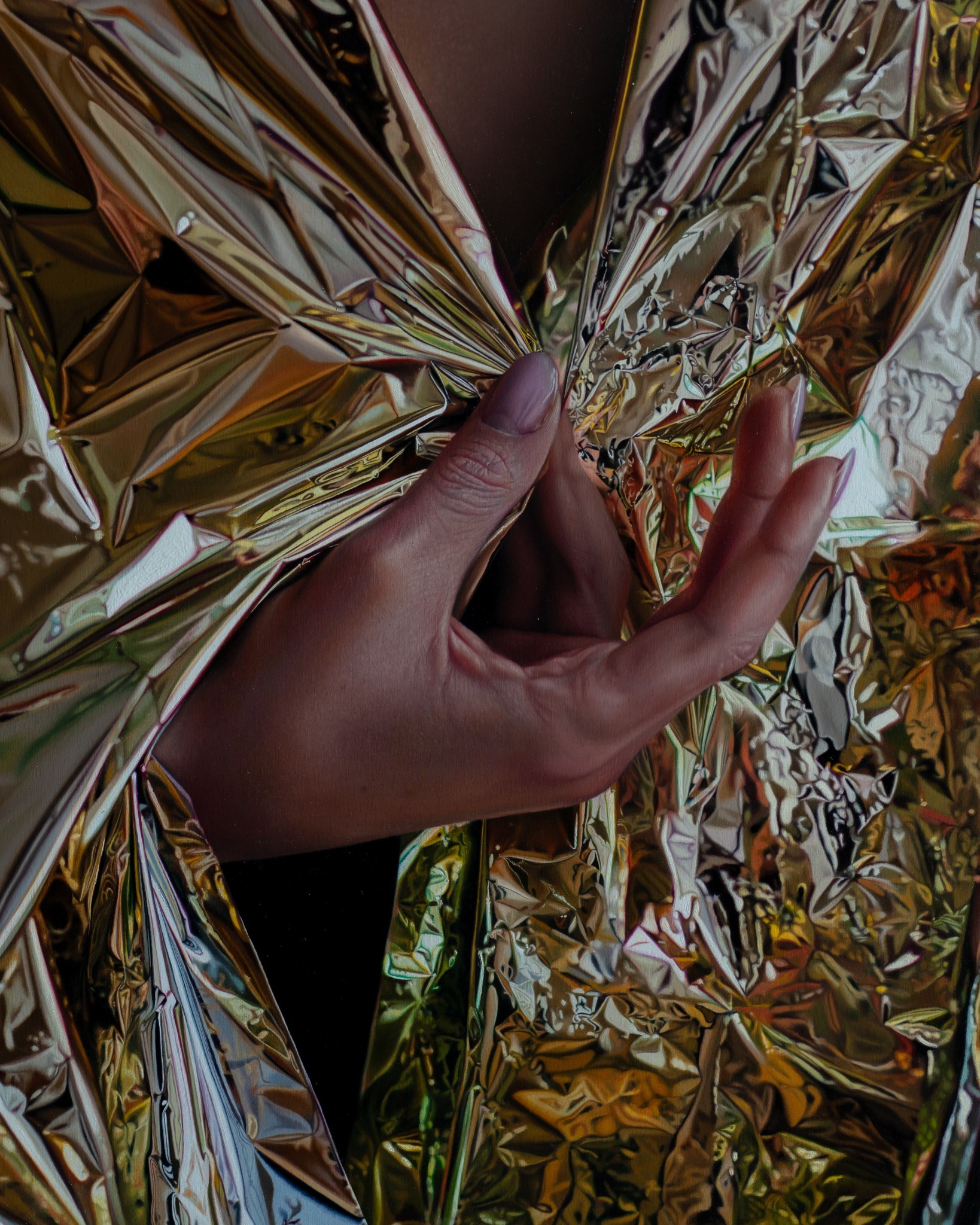
Detail of the intact painted portrait
Detail before intervention.
Detail of the scratched face with painted pseudo-code
Detail after intervention: abrasion and painted pseudo-code.

False Salvator Mundi began as a monumental hyperreal portrait built to produce visual certainty. I first painted the figure and face in full, using the precision of realism to construct a presence that felt immediate and believable. Then I intervened at the point where identity is most readily recognized: the face.

I physically scratched the painted portrait from the surface. The removed paint was not discarded. I collected it and preserved it in a glass jar. In practical terms, the portrait still exists, but no longer where a portrait is expected to exist. It has been displaced from image into object, from representation into residue, from appearance into a material archive.

The altered face was then overwritten with painted pseudo-code organized around layers of identity, body, behavior and social visibility. Its language resembles systems that classify, score, optimize and standardize a person. What began as a singular human presence is transformed into a field of categories and values.

The work therefore does not treat erasure as simple disappearance. The face is absent from the image yet materially present outside it. Hyperrealism first establishes trust; the physical removal of the portrait breaks that trust; the coded surface replaces recognition with classification.

For me, False Salvator Mundi asks what remains of identity when the image through which we recognize it is removed, measured and rewritten.

Jar containing the paint scratched from the portrait, held in front of the altered painting
The paint scratched from the portrait was collected and preserved in a glass jar.

The portrait was not simply erased. It was displaced from the image into matter.

Close view of the scratched portrait and painted code
The removed face and the system painted over what remains.

Sebastian Nasta (b. 1991, Romania) is a painter based in Cluj-Napoca, working primarily in oil on linen. His practice investigates the cultural authority of images and the unstable relationship between realism, belief and perception. Rather than approaching hyperrealism as a representational goal, he uses technical precision as a critical strategy: a way of slowing the viewer’s gaze and questioning the conditions under which an image becomes convincing.

His paintings move between portraiture, symbolic imagery and references to contemporary visual culture, often placing visual certainty in tension with conceptual ambiguity. Nasta completed both his BA and MA in Painting at the University of Art and Design in Cluj-Napoca. He has exhibited in Romania and internationally, including at Cluj Art Museum, Grand Palais in Paris, Kulturhaus Bruckmühle in Austria and Art Up! Lille. His work is held in private collections in Europe and the United States. He lives and works in Cluj-Napoca, Romania.

Curriculum Vitae — PDF